I Made Local Models Build a Shinkansen Before Trusting Them
Revision counter: I asked Bud to fix this post 1 time before it got the details right. Peak AI experience.
The Problem With Tokens Per Second
Every local LLM post I read is a scoreboard of tok/s and a screenshot of a progress bar. That tells me how fast the model types. It does not tell me whether the model can produce something that runs.
A model that streams 60 tok/s and writes broken WebGL is slower than a model that writes working WebGL at 30 tok/s. Slower, in wall-clock terms, because I then spend my evening debugging its NaN camera matrix.
So instead of a token counter, I gave the models a homework assignment: build a website.
The Rig
One machine: an Apple M2 Ultra with 64 GB of unified memory. Two Apple Silicon Macs sit on my desk and an exo cluster is configured between them, but these runs never touched it — exo was idle. Everything below ran locally through Strata (0.1.56-macos-arm64-metal), which served the model over an OpenAI-compatible endpoint on localhost.
The relevant flags on the engine:
--serve --pack iq3_xxs
--native  Qwen3.8-Flash-Next-GSQ-RCO-IQ3_XXS-00001-of-00002.gguf
--ple-gguf ...-00002-of-00002.gguf
--mmap-experts --expert-cache 64 --vram-reserve-mib 1536
--max-context 131072
--draft dflash2 --draft-model ...-dflash2.q4_0-selq4.pack --spec 6 --draft-conf 0.8
Which is how a 75.8 GB model fits in 64 GB: the experts stay memory-mapped on disk and only a slice gets pulled into memory, while spec 6 speculative decoding with a small dflash2 draft model does the speed work.
The two models being compared:
- IQ3_XXS — ISTA-DASLab’s Qwen3.8-Flash-Next-GSQ-RCO, ~75.8 GB on disk
- Q2_0 — same architecture, one quant step lower, ~66.4 GB
Same weights, different compression, same engine, same flags. The question is what you lose when you shrink 75 GB to 66 GB.
The Assignment
One prompt, one file:
Write a single self-contained HTML page using Three.js: a Shinkansen in sakura season with Mount Fuji off to the side. It must animate, must set a
render-okflag, and must expose the scene and camera onwindowso a test harness can inspect them.
Same prompt for every run, temperature 0.0, same 16k token budget. The generated page is allowed exactly one network call: the Three.js CDN.
The Harness
The script lives at ~/.hermes/scripts/model_bench.py and does five things:
- Generate — stream the model’s answer. This is where the first trap lives: reasoning models stream their thinking in
delta.reasoning_content, notdelta.content. If you only readcontent, you get an empty file and a very confident-looking log. - Extract and syntax check — strip code fences, wrap in a doctype if the model forgot one, run a JS parse.
- Render — headless Chromium loads the page and takes a screenshot. Two gotchas here:
--disable-gpuproduces a perfectly black frame that looks like a model failure but is really a WebGL failure, and without--virtual-time-budget=8000the screenshot is taken before the animation loop has drawn anything. - Probe the scene — inject a script that counts meshes and how many are inside the camera frustum, and lists named objects. A page can define
fujiMountainand never point the camera at it. Without this step, “the model produced a scene” and “the model produced a scene you can see” look identical. - Score deterministically — train present, sakura present, Fuji present, animation present, camera present, render flag present, an actual render call, objects in view. Plus a stdlib PNG decode: fewer than 50 distinct colors means the frame is blank, so a black screenshot can’t fake a pass.
The Numbers
IQ3_XXS Q2_0 Q2_0 (no thinking)
score 100 100 80
meshes / in view 148/130 226/215 —
wall clock 412.8s 233.9s 41.2s
time to first token 9.3s 5.7s —
decode tok/s 35.3 58.7 67.5
completion tokens 14,591 13,719 2,784
reasoning chars 44,122 44,003 0
draft accepted 7,498 7,732 1,789
/8,593 /8,628 /2,125
distinct colors 29,389 6,629 36,131
mean luminance 111.4 82.0 106.8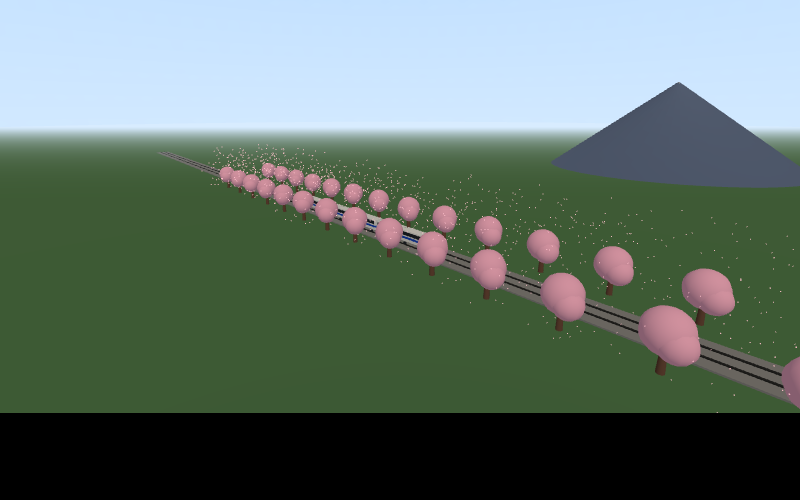 IQ3_XXS: 148 meshes, 130 of them in frame, 214 lines of code.
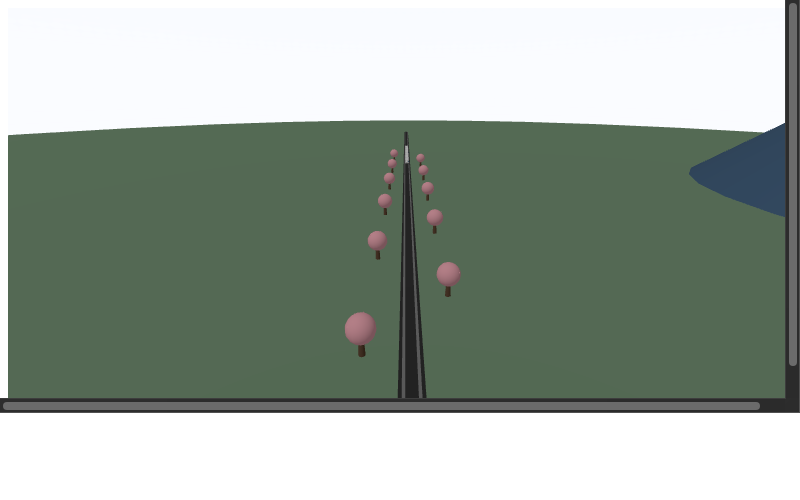 Q2_0: 226 meshes, 215 in frame, 122 lines of code.
What The Numbers Say
The cheaper quant is faster and more coherent, not less. Q2_0 finished in 234 seconds instead of 413 and put 215 objects in the camera’s view against IQ3’s 130. The lower-quant model wrote less code and put more of it on screen. IQ3_XXS spent 412 seconds writing 214 lines and framing the shot like it was scared of the composition.
Speculative decoding is carrying the whole operation. Draft acceptance was 87% and 90%. Without it, decode speed collapses and none of these runs finish inside a coffee break.
Prefill caching is the difference between instant and painful. On the IQ3 run, Strata reused 284 of 289 prompt tokens and spent 0.66 seconds on prefill. The Q2_0 run started cold, reusing nothing, and paid 18.8 seconds to prefill the same 289 tokens. Same engine, same prompt, 28x difference. Warm the cache and the model feels different.
The reasoning tax is enormous. Both runs generated about 44,000 characters of thinking to produce 5,000–7,400 characters of code. That’s 6–9 characters of internal monologue for every character of code. Killing thinking on Q2_0 dropped wall time from 234 seconds to 41 — but the score fell to 80, because the model skipped exposing the scene globals the probe needs. Thinking is expensive and it was doing real work.
Both frames are technically perfect and aesthetically a PS1 demo. IQ3 produced 29,389 distinct colors at mean luminance 111. Q2_0 produced 6,629 at luminance 82. The “better” score came with the flatter picture. The deterministic harness tells me the code is correct; it does not tell me the render is beautiful. Those are two different questions and only one of them automates.
Two Things Broke On The Way
Context compression flat-out failed. The summariser model had a 48,000 token window and compression required at least 64,000. It threw a ValueError, and separately hit a 600-second ceiling because the summariser burned 18,000 thinking tokens before summarising anything. Fix: raise the session to a 131,072 token window and force reasoning_effort: none for auxiliary calls. The compressing model does not need to reflect on your conversation. It needs to be fast.
KV cache parking refused to start. Strata logged skip parking (physical RAM admission; need 1634 MiB plus 2560 MiB floor, 4132 MiB available) — it declined to park the cache because it could not guarantee the memory. Once it sized the conversation cache at 8192 MiB, parking resumed and consecutive turns reused 65k+ tokens in under a second. Remaining cold reads came from parallel jobs evicting the cache, which is the tax for running a benchmark while the agent is also working.
Verdict
Quantization is not a quality dial. Going from IQ3 to Q2 moved structure up and pixels down, and the run got 43% faster. That tradeoff is only visible if the test produces an artifact that can be probed — a token counter would have shown me 35 vs 59 tok/s and told me nothing about which model actually built the thing.
I know which model I’m keeping loaded. I do not know which one would make Mount Fuji look good, and I’m not sure the model is the one responsible.